Apple · Field note 008
iPhone Duo opens Apple’s foldable era
Apple’s first folding iPhone pairs a compact outer screen with its largest iPhone display and an iOS experience rebuilt around two surfaces.
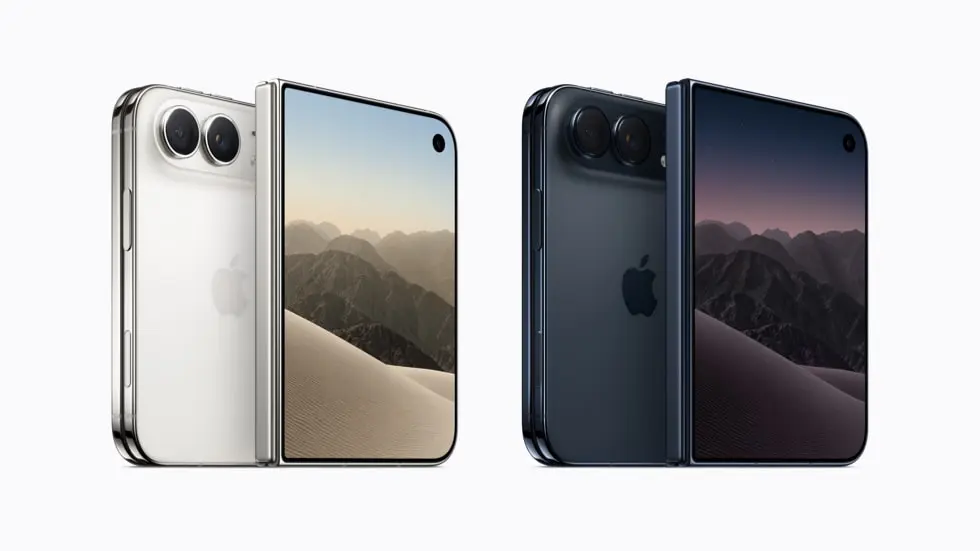
The iPhone Duo is not simply a larger iPhone with a hinge. Apple is using the fold to reconsider how iOS, cameras, multitasking, and even authentication work across two displays.
Closed, iPhone Duo presents a 5.4-inch outer Super Retina XDR display in a body Apple compares in size to a passport. Open it and a 7.6-inch inner display becomes the largest screen Apple has put in an iPhone—50 percent larger than the display on iPhone 18 Pro Max.
The two panels share an aspect ratio so content can move between them without abruptly changing shape. Both support ProMotion, Always On, and up to 3,000 nits of peak outdoor brightness. The inner display uses a nano-texture finish to reduce reflections and make the crease less visible, while a FaceTime camera remains hidden beneath it when not in use.
The hinge becomes part of iOS
iOS 27 adapts its controls, Dock, status information, and Dynamic Island to the available screen. Opened, the phone can show two Home Screen pages and Today View. Split View brings two apps side by side, supports two windows from the same app, and lets users save app pairs for later.
The hardware can also rest at different angles. StandBy works on either screen even when the phone is not charging, and the device can prop itself up for calls, photos, or video. Apple says support for Apple Pencil with USB-C will arrive later in the year.
Touch ID moves into the side button, offering a consistent unlock point whether the phone is open or closed. The frame uses polished grade 5 titanium, while the hinge contains more than 100 components and a 3D-printed titanium cover. Apple rates the device IP68 for water and dust resistance.
Cameras made for two displays
The rear system includes 48-megapixel Main and Ultra Wide cameras. The Main camera can capture at 48MP, use a 24MP default, or provide an optical-quality 2x view. The Ultra Wide handles wider scenes and macro photography, while a Center Stage front camera automatically adjusts framing and orientation.
The folding design enables several new shooting modes. Duo Preview places the live frame on the outer screen for the subject to see. Users can take higher-resolution selfies with the rear cameras, while Smart Take watches for posed subjects and captures the moment automatically. Kid Cue uses Peanuts animations on the outer display to direct a child’s attention toward the camera.
The phone can record 4K Dolby Vision at 120 frames per second with its Main camera. Its partially folded position can also replace a tripod for longer recordings.
Pro hardware in a different shape
Inside, iPhone Duo uses the same A20 Pro family as the iPhone 18 Pro. Apple pairs it with a custom vapor chamber and a new display engine that drives both panels. The company claims up to 35 percent better sustained performance than iPhone 17 Pro, along with Wi-Fi 7, Bluetooth 6, Thread, and its C2 cellular modem.
A battery sits on each side of the fold and the two operate as one system. Apple rates video playback at up to 31 hours on the inner display or 44 hours on the outer screen, with up to 24 hours of mixed-display use. The phone is eSIM-only worldwide and can charge to 50 percent in about 20 minutes by cable.
A premium first generation
iPhone Duo comes in star white and night sky, with storage from 256GB to 2TB. It starts at $1,999 in the United States. Preorders open October 16, and availability begins October 23.
That price makes Duo a specialized device, but its larger significance is clear. Apple is treating the fold as a new interaction model—not merely a way to fit a tablet-sized panel into a pocket.